
The creator of Rails flew a thousand Rails developers to Austin to tell them he no longer writes code, his flagship product is moving to Rust and native apps, and the correct emotional posture is total optimism. A review of the most confident hour in framework history, and the one question it never got round to.
Every industry has a moment when the founder walks on stage at the company conference and announces that the product is fine, really, but he has personally moved on. Car people get the CEO who arrives on an electric scooter. Rails people, it turns out, get an hour in Austin on 23 September 2026 in which David Heinemeier Hansson explains that 37signals has gone “pencils down” on hand-written code, the next version of HEY will be six native apps and a mail server written in Rust, and the only play left for the thousand or so developers in the room is “total optimism”.
He tweeted beforehand that the talk “might ruffle a few feathers”. This is the keynote equivalent of a man announcing he is about to say something controversial, then saying it at a volume audible from Dallas. Feathers were ruffled. By the next morning the Ruby forum thread was relaying “the buzz on the street is that DHH has lost his mind”, and the Hacker News thread had someone replying “watch the entire keynote”. Both are fair, and we watched the whole thing, so let us be precise about what was actually said before we are rude about it.
Some of this keynote is right, and the right parts are not small.
The ask that every app should ship a command-line interface “by next Friday” is the best product advice given at a Rails conference in years. If agents are going to act on a person’s behalf, they need a front door that is not a chat widget bolted to your marketing site. His phrase for it, “let me bring my own butler”, is exactly the correct posture for a buyer, and the demo that went with it (an agent on the HEY CLI digging up a five-year-old email from nothing but “sneakers and a podcast”) is the kind of thing that sells itself.
The HEY numbers, if they hold, are also genuinely impressive. The rewritten mail server is reported at 99% less CPU and 95% less memory, running on ten hosts kept “purely for redundancy”. He caveated the line about peak traffic fitting on a Raspberry Pi as a rough estimate, which is more caveat than most AI keynotes contain in total. A small team shipping six native apps is a real change in what small teams can do. Nobody serious disputes that the tools got much better in the last year.
Hold that thought. Now the rest of it.
The talk dates the “age of agents” to 24 November 2025, which the Japanese summary ties to the release of a particular frontier model, and calls that moment “the Kodak Brownie of our era”. The Brownie is a good analogy for democratised creation. It is a slightly awkward one for a man telling programmers their craft is over, because the Brownie did not end photography. It ended the need to hire a photographer for your holiday snaps, and it produced, by his own slide, two trillion photos a year, of which a rounding error are any good. Professional photography did not die. It got smaller, more expensive, and more about judgement than about the chemistry.
That is a perfectly defensible thesis. It is not the thesis the keynote chose. The keynote chose “hand-writing code is no longer economically viable”, which is the version of the Brownie story narrated by Kodak’s marketing department.
And there is something quietly remarkable about the creator of Rails, a man who has spent twenty years arguing that software is a craft and that vendors should not own your stack, dating the new epoch of human history to a vendor’s launch day. Previous epochs have been dated to the printing press and the steam engine. This one has a changelog.
Here is the number that should make every engineering manager in that room put their coffee down. According to the Dealroom write-up, he said he wrote 150,000 lines in August 2026 alone, against a long-run average of around 30,000 lines of production Ruby a year, and that he has produced half his career’s output in the past twenty months.
For two decades the Rails pitch was that lines of code are a cost. Fewer is better. Beautiful code is short code. Convention over configuration exists precisely so that you write less of it. The man who built a framework on that premise has now stood in front of its users and reported his productivity in lines, in the same register a 2004 enterprise consultancy used to bill by the KLOC.
Five years of production Ruby, in one month. We would like to meet the person who reviewed it. We suspect the answer is another agent, and we suspect the person who reviews that agent is the one question this keynote never asked.
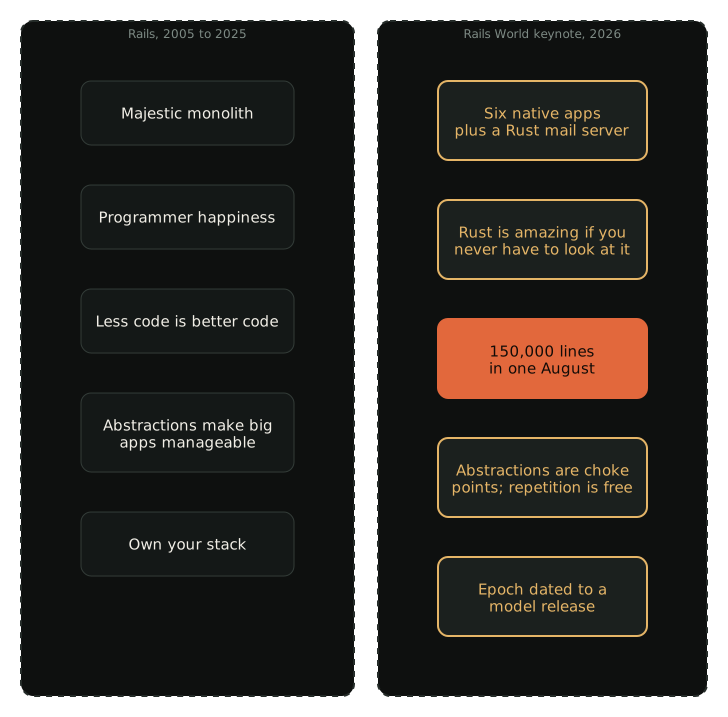
This is the line people will quote, and they should, because it is the whole keynote in eleven words. Rust, he said, is amazing if you never have to look at it yourself. The mail server is in Rust. He does not read Rust. The talk frames this as a feature: not knowing the language lets you judge the system from the outside, on behaviour and results.
That is a sentence that works beautifully right up to the first incident. Behaviour and results are what you judge when the thing is working. When it is not working at 3am, somebody has to look at it, and “the agent will look at it” is a plan with the same shape as “the intern will look at it”, minus the intern’s ability to be fired. We have written before that the cost of AI output lands on the reviewer; here the reviewer has announced, from a stage, that he has chosen not to be able to review. It is a bold position for the person whose name is on the product that stores your email.
He also said, as reported, that abstractions (the tool that made large codebases survivable for half a century) turn into choke points when thousands of agents mutate an app, and that repetition is now nearly free. Repetition is free to write. It has never been free to change. Anyone who has fixed the same bug in eleven copy-pasted controllers knows exactly where the bill arrives, and it is not in the month you wrote them.
The most revealing story in the talk was presented as a speed bump. Early in Basecamp 5, designers “vibe-coded” final features as individual pull requests, and combined, the architecture came out looking, in the reported phrase, “like Swiss cheese”. The lesson drawn was that the process needed tuning, and the agent-accelerated version then shipped.
That is one lesson. Another is that when you let everyone with a keyboard generate code, the thing that breaks first is the whole, and the thing that rescued it was people who understood the whole. 37signals has some of the most experienced Rails engineers alive. Their “pencils down” works because they spent twenty years holding pencils. The keynote’s audience included a lot of people who have held one for two, and the advice they took home was that the pencil is obsolete.
This is the part of the talk that should worry a manager more than any of the numbers. The keynote generalises from a team that can tell Swiss cheese from cheddar on sight to a room that mostly cannot yet, and it tells that room to stop practising.
Some claims deserve only to be read aloud. The talk reportedly put the gap between the worst programmer without agents and the best with them at approaching 1,000x. The best anything with power tools against the worst anything without them will always produce a large number; the comparison tells you about the choice of endpoints. By the same method, the gap between a Formula 1 driver and a man pushing a shopping trolley approaches infinity, and nobody concludes that walking is over.
Then there was Omarchy, his Linux distribution, whose install time went from 3 minutes 33 seconds at Rails World 2025 to 35 seconds on a laptop last week and 9 seconds “in the lab”. The foundation behind it announced a $3 million commitment from Alibaba Cloud the day before the talk, taking its reported backing to about $21.7 million, alongside an “Omarchy China” and a partnership on an agentic laptop. We make no claim about any of that beyond this one: the Rails World opening keynote, at a Rails conference run by the Rails Foundation, spent its closing stretch on a Linux distro, a calculator designed from an image in seven minutes, a video trimmer, and a Markdown slide tool shipped as a half-megabyte binary the week of the talk. In fairness, it was a very nice slide tool. It was the slide tool he presented with. So the man showed you the future of software on a thing he wrote that week, and the thing was a way to show slides.
To be fair, the talk had an answer. Rails’ convention over configuration, it argued, is token efficient: an agent writing Rails needs fewer words to be right, and a one-person framework suits the one-person-plus-agents shop. The Rails Foundation’s agent evals, run by Evil Martians, are already saturating their first benchmark at 95% completion.
Read that pitch back slowly. The case for Rails in 2026, from its creator, is that it is cheap for a machine to write, because it costs fewer tokens. The founding argument, that it was pleasant for a person to read, did not come up. That is a real advantage, and it is also the argument a framework makes when it has been demoted from the product to the substrate. Nobody chose Rails in 2006 because it was efficient for the compiler.
Meanwhile, in the same hour, 37signals’ own newest backend work moved to Rust and its newest clients to six native apps. The forum’s “Rails is dead” take is wrong; the web app keeps its place for Basecamp-shaped software with visitors and outside collaborators, and he said so. But the framing left a thousand people who bet their careers on Rails with an odd message from its author: Rails is great, it is ideal for agents, and our most interesting new systems are not in it.
Strip the showmanship and three things survive, and they are worth doing.
Ship a CLI or an API an agent can drive, because your customers will want to bring their own butler and the vendor without a door gets routed around. Write your conventions down, since agents follow written conventions and ignore tribal ones, and Rails teams are unusually well placed to do this. And measure the gate: how many seconds a competent person spends deciding whether agent output is correct, and how many of those decisions your team can make in a week. That number, not lines per month, is your throughput.
What does not survive is “pencils down” as general advice. It is a sound policy for a team whose every member could write the code if the agent failed, which is precisely the team described. It is a dangerous one for anyone still building that ability, because judgement about code is learned by writing code, and the talk’s own Basecamp story shows what happens when the people generating it cannot see the whole.
We should admit the limit. We are reading the talk through two write-ups and an hour of video without a clean transcript, so a joke or two may have landed as a claim. He is also right far more often than his critics admit: the monolith, the cloud exit, the remote work arguments all looked contrarian and aged well. It is entirely possible that in three years “pencils down” reads as obvious and this piece reads as a man shouting at a Brownie.
But the keynote asked for total optimism, and optimism is an emotion. A plan is the dull part: somebody accountable reads what the machine wrote, before it touches your customers’ email. The most confident hour in framework history spent sixty minutes on everything except who that somebody is.
Support automation, AI phone agents, n8n back-office work, and the engineering loop itself — always behind a gate you control.